



- Company
- Products
- Catalogs
- News & Trends
- Exhibitions
Animal feed supplement Lactolevurecalffor pigletsgoat

Add to favorites
Compare this product
Characteristics
- Type
- for animals
- Animal type
- calf, goat, for piglets, lambs
- Main ingredient
- vitamin E, calcium, sodium, phosphorus, protein, with yeast, sugar, lactose, electrolytes
- Form
- liquid, gel
- Function
- for intestinal health, stimulate appetite, for lactation, for weaning
- Other characteristic
- postbiotic
Description
DESCRIPTION
The first weeks of life decide much of a batch's profitability. A piglet, lamb or calf that is born light, does not take colostrum well or faces early stress from transport, heat or weaning takes longer to get going, grows less and is harder to rear. And the switch from milk to solid feed is another critical moment: the sooner it starts eating, the less it loses at weaning.
Lactolevure is AMBiotec's complementary feed to maternal milk for suckling animals. It comes as an isotonic gel with a culture of inactivated yeast and its fresh metabolites, together with a dairy input (lactose) and electrolytes. It is the postbiotic of the range: it does not provide live yeast but what the yeast produces when it ferments, ready to act from the first intake. It is intended for calves, lambs, kids and piglets, and is offered in a dish, freely available.
The yeast metabolites support the balance of the young animal's digestive microbiota; the dairy input and the electrolytes provide energy and help to maintain hydration; and its texture and taste get the animal used to eating away from its dam, which prepares the move to starter feed.
WHAT IT BRINGS TO THE FARM
Practical points: offer it in a clean dish and renew it daily; from 15 days of age, add small amounts of pre-starter feed to the dish to introduce the animal to solid feed; keep the jerrycan tightly closed between uses; and, because of its short shelf life, order and rotate the product according to expected consumption.
COMPOSITION AND NUTRITIONAL COMPONENTS
The first weeks of life decide much of a batch's profitability. A piglet, lamb or calf that is born light, does not take colostrum well or faces early stress from transport, heat or weaning takes longer to get going, grows less and is harder to rear. And the switch from milk to solid feed is another critical moment: the sooner it starts eating, the less it loses at weaning.
Lactolevure is AMBiotec's complementary feed to maternal milk for suckling animals. It comes as an isotonic gel with a culture of inactivated yeast and its fresh metabolites, together with a dairy input (lactose) and electrolytes. It is the postbiotic of the range: it does not provide live yeast but what the yeast produces when it ferments, ready to act from the first intake. It is intended for calves, lambs, kids and piglets, and is offered in a dish, freely available.
The yeast metabolites support the balance of the young animal's digestive microbiota; the dairy input and the electrolytes provide energy and help to maintain hydration; and its texture and taste get the animal used to eating away from its dam, which prepares the move to starter feed.
WHAT IT BRINGS TO THE FARM
- A start for weak animals: supports the viability of low-birth-weight piglets, lambs, kids and calves, with an energy and protein supply from the first day.
- Vigour and weight during suckling: supports growth during the suckling period and helps to reduce losses at this stage.
- Introduction to solid feed: encourages early intake of feeds other than maternal milk and pre-starter feed, which is key for weaning.
- Weaning with less stress: shortens the period of negative energy balance at weaning and reduces weight loss.
- Microbiota and stress: supports the balance of the digestive microbiota in stressful situations such as heat, transport or arrival at the feedlot.
- Piglets: suckling, weak animals, pre- and post-weaning and recovery of tail-enders.
- Calves: newborn suckling calves and on arrival at the fattening unit.
- Lambs and kids: newborns, twin births, collection for the feedlot or artificial rearing and recovery of tail-enders at weaning.
- Administration (label): orally, in a dish, freely available. Shake before use.
- Piglets (technical data sheet): during the first 14 days of life, 750 ml per piglet. For weak piglets, 2 ml directly into the mouth for two days.
- Piglets pre- and post-weaning (technical data sheet): 50 ml per piglet per day mixed with the starter feed (mash) for 7 days; on the day of weaning and the day after, the same schedule.
- Recovery of piglet tail-enders (technical data sheet): 100 ml per piglet mixed into the weaning feed until the desired weight is reached.
- Newborn suckling calves (technical data sheet): 50 ml per calf per day for the first 14 days, mixed with maternal milk or milk replacer, especially in dairy replacement heifer calves.
- Suckling calves on arrival at the fattening unit (technical data sheet): 100 ml per calf per day for the first 7 days, with milk replacer or in the drinking water.
- Piglets and calves in stressful situations (technical data sheet): 100 ml per animal per day for as long as the situation lasts.
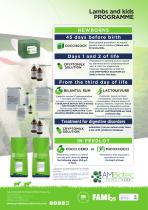
- Newborn lambs and kids (indicative brochure guideline): 2 ml into the mouth with the doser on the day of birth; in twin births, freely available in a dish during the first 14 days.
- Lambs collected for the feedlot or artificial rearing (indicative brochure guideline): 2 ml into the mouth on the first day and 5 ml per lamb per day for the following 14 days.
- Recovery of lamb tail-enders at weaning (indicative brochure guideline): 10 ml per lamb per day with the feed or in the drinking water.
Practical points: offer it in a clean dish and renew it daily; from 15 days of age, add small amounts of pre-starter feed to the dish to introduce the animal to solid feed; keep the jerrycan tightly closed between uses; and, because of its short shelf life, order and rotate the product according to expected consumption.
COMPOSITION AND NUTRITIONAL COMPONENTS
- Composition: water, lactose, dextrose, sucrose, ammonium phosphate, sodium chloride, sodium butyrate, potassium chloride and sodium bicarbonate.
- Additives (per kg): mixture of flavouring substances 12.98 mg. Technological additives: sepiolite (1g562) 38,610 mg; sodium citrate (E331) 2,420 mg; potassium sorbate (1k202) 2,200 mg. Nutritional additives: vitamin E (3a700ii) 1.54 IU.
- Nutritional components: moisture 90 %, crude protein 4.4 %, crude fibre 0.8 %, crude oils and fats 0.5 %, crude ash 1.7 %, calcium below 0.02 %, sodium 121 ppm, phosphorus 0.23 %, magnesium below 0.1 %, lysine below 0.1 %, methionine below 0.1 %.
- Physico-chemical properties: white liquid gel, neutral taste and characteristic odour; density 1.05 g/ml at 25 °C; pH 5.5 ± 1.
- How the formula works: the yeast metabolites are the postbiotic part; the sugars, lactose and electrolytes provide energy and hydration; and the isotonic gel base allows it to be offered in a dish for the animal to take on its own.
- Postbiotic: inactivated yeast and its metabolites; the yeast does not need to be alive to act.
- Natural origin: ingredients of natural origin, with no known side effects, that do not generate resistance.
- No withdrawal period: no withdrawal period is required for meat or milk.
- Label contraindication: simultaneous use of different organic acids or their salts is contraindicated when one or more of them is used at or close to the maximum permitted content.
- Veterinary judgement: Lactolevure is a complementary feed and does not replace the diagnosis or judgement of the veterinarian responsible for the farm.
- Formats: 5 kg and 20 kg jerrycans.
- Shelf life: best used within the month following manufacture (technical data sheet).
- Storage: keep the container tightly closed, in a cool (not above 25 °C), dry place, away from heat sources and sunlight.
- Category: complementary feed to maternal milk for calves, lambs, kids and piglets.
- Registration number: ESP45000371.
- Manufacturer: manufactured and marketed by Agroalimentaria Manchega de Biotecnología, S.L. (AMBiotec), Toledo (Spain).
- Management systems: FAMI-QS, ISO 9001 and ISO 14001.
- R&D&I: formulation developed in AMBiotec's own R&D&I laboratory, which analyses raw materials, feed, water and faeces as part of its technical service to farms.
Catalogs
Exhibitions
Meet this supplier at the following exhibition(s):

Other AMBiotec products
DAIRY CATTLE


Related Searches
- Animal nutritional supplement
- Nutritional supplement
- Solid feed supplement
- Mineral nutritional supplement
- Cattle nutritional supplement
- Vitamin nutritional supplement
- Digestion nutritional supplement
- Supplementary feed for the immune system
- Poultry nutritional supplement
- Deficiency corrector supplementary feed
- Protein nutritional supplement
- Liquid nutritional supplement
- Pig nutritional supplement
- Powder nutritional supplement
- Sheep nutritional supplement
- Reproduction nutritional supplement
- Goat nutritional supplement
- Equine feed supplement
- Licking block
- Licking block with trace elements
*Prices are pre-tax. They exclude delivery charges and customs duties and do not include additional charges for installation or activation options. Prices are indicative only and may vary by country, with changes to the cost of raw materials and exchange rates.