



Animal feed analyzer RA-915 Labsoiloilwater


Add to favorites
Compare this product
Characteristics
- Analyzed product
- soil, water, animal feed, oil, ash, urine
- Configuration
- benchtop
Description
Overview
RA-915 Lab is an automated laboratory direct mercury analyzer with optional 45-position autosampler. It performs direct thermal decomposition without chemical pretreatment or reagents, producing minimal waste. Designed for environmental, industrial, geological and life-science matrices, the system delivers reliable, high-selectivity Hg analysis and supports a wide dynamic range.
Principle of operation
Direct thermal decomposition followed by atomic absorption spectrometry at 254 nm with Zeeman background correction for interference-free, selective measurements.
Features and benefits
Applications
Suitable for direct determination of mercury in multiple matrices, including:
Standards compliance
Mercury determination with RA-915 Lab complies with widely adopted standards based on direct thermal decomposition, including ASTM D6722, ASTM D7622, US EPA 7473/30B/PS12B, EN/TS 17286, SN/T 4429.2-2016, HJ 923-2017 and others.
Software
RAPID software controls RA-915 Lab and is FDA 21 CFR Part 11 compliant. It provides:
Additional information
Automatic closed-loop temperature control and thermoscanning extend the measurement range and enable mercury speciation analysis. Standard warranty: 1 year. Installation, commissioning, support and operator training are available by qualified specialists.
Caractéristiques / spécifications techniques
RA-915 Lab is an automated laboratory direct mercury analyzer with optional 45-position autosampler. It performs direct thermal decomposition without chemical pretreatment or reagents, producing minimal waste. Designed for environmental, industrial, geological and life-science matrices, the system delivers reliable, high-selectivity Hg analysis and supports a wide dynamic range.
Principle of operation
Direct thermal decomposition followed by atomic absorption spectrometry at 254 nm with Zeeman background correction for interference-free, selective measurements.
Features and benefits
- Direct and rapid analysis of solids, liquids and biosamples
- Low detection limits and high selectivity due to Zeeman background correction
- Extended dynamic range up to 2,000,000 ppb suitable for diverse applications
- No sample pretreatment or reagents required, lowering operating costs
- Safe and simple operation: no compressed gases required (air as carrier)
- No pre-concentration on gold traps, increasing throughput and reducing complexity
- No memory effect: low-concentration samples can follow high-concentration ones immediately
- Programmable furnace for optimized decomposition and mercury thermospeciation studies
- Optional 45-position autosampler with loading-on-the-go capability
Applications
Suitable for direct determination of mercury in multiple matrices, including:
- Soils, sediments, rocks, ores, minerals
- Food, food additives, animal feed
- Crude oil, oil products, naphtha, petrochemicals
- Biosamples: tissues, hair, urine, blood
- Wastewaters, wastes, sludge
- Coal, coke, fly ash, gypsum
- Sorbent traps for stack gases and passive air samplers
- Drugs, cosmetics, plastics, fertilizers and other materials
Standards compliance
Mercury determination with RA-915 Lab complies with widely adopted standards based on direct thermal decomposition, including ASTM D6722, ASTM D7622, US EPA 7473/30B/PS12B, EN/TS 17286, SN/T 4429.2-2016, HJ 923-2017 and others.
Software
RAPID software controls RA-915 Lab and is FDA 21 CFR Part 11 compliant. It provides:
- Data acquisition, processing and reporting
- Real-time visualization of selective and non-selective absorbance
- Databases for calibrations and measurement storage
- Adjustable modes for optimized thermal decomposition of specific matrices
Additional information
Automatic closed-loop temperature control and thermoscanning extend the measurement range and enable mercury speciation analysis. Standard warranty: 1 year. Installation, commissioning, support and operator training are available by qualified specialists.
Caractéristiques / spécifications techniques
- Measurement principle: Direct thermal decomposition followed by atomic absorption spectrometry at 254 nm with Zeeman background correction
- Detection limit (general): 0.2 ppb (µg/kg)
- Measurement range: 0 – 2,000,000 ppb (µg/kg)
- Sample boat capacity: 5,000 mg; 2,800 µL
- Analysis time: 1 – 5 min
- Analyzer warm-up time (max): 40 min
- Temperature range of atomizer and analytical cell: 50 – 950 °C
- Autosampler capacity: 45 samples
- Analyzer power supply: 110 – 240 VAC, 50 – 60 Hz
- Power consumption (max): 2000 W
- Dimensions (W×D×H): 450×840×460 mm (with autosampler); 450×490×460 mm (without autosampler)
- Weight: 57 kg (with autosampler); 40 kg (without autosampler)
- Detection limits by matrix:
Soils, rocks, sediments: 0.5 ppb (µg/kg)
Water and solutions: 0.2 ppb (µg/L)
Foodstuff: 0.5 ppb (µg/kg)
Biological samples (tissues, blood, hair, etc.): 0.5 ppb (µg/kg)
Crude oil, gas condensate: 1 ppb (µg/kg)
Naphtha: direct - 1 ppb (µg/kg); preconcentration - 0.05 ppb (µg/kg)
Coal: 1 ppb (µg/kg)
Sorbent traps for stack gases: 0.5 ng (range 0.5 - 50,000 ng)
VIDEO
Catalogs
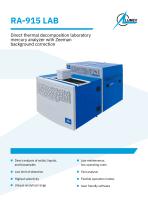
RA-915 Lab
4 Pages
Other Lumex products
Mercury analyzers


Related Searches
- Portable analyzer meter
- Moisture analyzer meter
- Lumex benchtop analyzer
- Grain analyzer meter
- Protein analyzer meter
- Analyzer meter with data logging
- NIR analyzer meter
- Lumex in-line analyzer
- Milk analyzer
- Soil analyzer meter
- Lumex animal feed analyzer
- Total fat analyzer
- Flour analyzer
- Lactose analyzer
- Fruit analyzer meter
- Lumex oil analyzer
- Compact analyzer
- Starch analyzer
- Lumex water analyzer
- Soybean analyzer
*Prices are pre-tax. They exclude delivery charges and customs duties and do not include additional charges for installation or activation options. Prices are indicative only and may vary by country, with changes to the cost of raw materials and exchange rates.